Mom Needs Care and Siblings are in Disagreement

Founder and Executive Director Linda Fodrini-Johnson, MA, MFT, CMC

Founder and Executive Director Linda Fodrini-Johnson, MA, MFT, CMC

Often we hear from families, that need services for a parent, that their brother or sister doesn’t think mom needs anything or they feel she needs 10 times the care she really needs to stay safe and well.  This conflict can sometimes delay an intervention that would benefit all family members.

It is hard to accept that a parent is in need of an intervention due to cognitive decline that might impair judgment and safety.  It is also hard to insist that a parent needs help who is physically frail but resists having help.  Often this resistance stems from the unfounded idea that accepting care might be a signal that the family might try to move them from their beloved home.  Having a consultation with a professional Geriatric Care Manager or attending a class for “family caregivers” often allows all the family to hear the same information and make more informed decisions.

Finding the right balance of services for mom, that allows her to retain her dignity but keeps her safe, should be the goal of meetings with geriatric professionals.  Mom’s values will have to be considered in any major decision in order to preserve quality of life.   It is important that families choose to work with someone who is certified as a care manager and a member of the National Association of Professional Geriatric Care Managers.

Making pre-mature and not well thought out decisions can cause great stress to families – know your options, know the costs and look for solutions that respect the dignity and values of the older person.

Eldercare: Does your employer support your challenges?

Founder and Executive Director Linda Fodrini-Johnson, MA, MFT, CMC

Founder and Executive Director Linda Fodrini-Johnson, MA, MFT, CMC

Our business is helping families with the challenging issues of aging.  Sometimes it is getting siblings to agree on a decision of what is best for mom. Other times it is helping a family get the diagnosis they need so they can plan for the future or take control from someone who is impaired cognitively and at risk for self-abuse or exploitation.

All of a sudden, as an employer, I looked in the mirror and found that out of 43 professional and support staff, I had 8 (almost 20%) of our employees in the depths of “eldercare” experiencing all those dilemmas that our clients families deal with every day.  I myself have an 88-year old mother that lives alone and at any juncture, I could be in the same place as my staff.  Actually, when the phone rings late at night, I always hold my breath thinking it could be Mom in a health care crisis.

When I realized this and looked at the time these individuals were putting into the caregiving role, I decided we needed to do something. I asked one of our licensed social workers/geriatric care managers to lead a brown bag lunch support group – at least once a month.  How easy it is to offer this support to employees, as any employer could hire a professional geriatric care manager to lead these groups at very little cost to the company – but great relief to the stressed employee who sometimes doesn’t know where to turn.

When you realize you are not alone, when you realize creativity is needed in caregiving and when you know how to advocate for your loved one, you are in a better place to care for yourself.

Ask your employer to secure a support group at work because, I bet, most places of employment have 12-15% of their staff in elder caregiving roles that could be affecting their employer’s productivity.

Seniors, Medicare & Health Care Reform

Founder and Executive Director Linda Fodrini-Johnson, MA, MFT, CMC

Founder and Executive Director Linda Fodrini-Johnson, MA, MFT, CMC

There was recently an online streaming broadcast about Health Care Reform provided by the website www.healthreform.gov where some great information was obtained .  Below, I have summarized what was said about the most recent law affecting Health Care Reform:

1. This new bill does not eliminate anything Medicare currently offers.

2. Starting in 2011, Medicare will not charge for preventive care check-ups and regular physicals.  No co-pay and no deductible.  This includes colonoscopies, which are considered preventive.

3. Seniors who have hit the gap in drug coverage, known as the donut hole, will receive a $250 rebate starting in June or as soon as the donut hole is reached.

4. Senior Medicare Patrol is ramped up to prevent scam artists and fraud to seniors.  The Patrol will also be available to educate seniors on their Medicare benefits by helping them to read about their coverage and interpret their benefits.

5. Early retiree insurance pools will begin in 2014.  Medicare will be offered to those who are forced to retire early or decide to retire early.  New rules will be in place to employers and insurance companies so they do not prevent access to health care upon early retirement.

6. Retiree drug plans will continue to be fully protected.

7. The “high risk pool” are adults or seniors with pre-existing conditions.  This group of people will see a cap on their premiums as of 2014.

For more information look at the following credible website:  http://healthreform.gov/

Team Work – My Team of Senior Advocates

Founder and Executive Director Linda Fodrini-Johnson, MA, MFT, CMC

Founder and Executive Director Linda Fodrini-Johnson, MA, MFT, CMC

I have a wonderful company to lead and we always refer to ourselves as the “team”.  No matter what you do or what your job description is, you work for a common goal. In our case, it is quality of life for elders and peace for families.  We acknowledge that the journey of aging can be stressful and very hard for individuals and families to seek help.  We all think we should be able to do anything alone – forgetting we can’t excel at all elements of life – we just can’t be objective when it concerns someone we love.  We turn to doctors, lawyers, accountants, and we should also turn to those who have expertise in any area we find challenge or dilemma.

One of the values for families using Eldercare Services Professional Care Managers in the San Francisco Bay Area is that we resource each other when looking to solve a problem or find an appropriate resource/service for a client.  This means that the “collective wisdom” of 20 very experienced, well prepared and certified care managers is sourced for every challenge the family faces.  This is the reason many families choose our company over others who may have limited professional expertise.

Adding a Geriatric Care Manager to your family’s team gives them the ability to use objective eyes to see with clarity what they can’t because of past history, unrealistic expectations and sometimes just denial.   The professional Care Manager will help the family see, in their own time, what they need to see, will guide them in the options available, help them with challenging decisions and act as an advocate when or if needed.  They are the “quarterback” on your family’s team – making calls that will meet the goal of winning, when it comes to peace, during a crisis or challenging decision.

Sometimes a family only needs a map on how to get from base to base and other times they need a coach, a trainer and a shoulder to lean on when the process is tough. Teams need leadership but the leader should always take into consideration the value and goals of the client. That is what we do on our team at Eldercare.  We make recommendations based on past history, client values and existing resources.  The client (older adult) is our primary focus; however, the entire family is always in the broader picture.

What is the First Step to Getting Help for Your Senior Loved One?
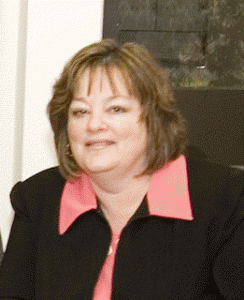
Sandi Gunnett, BS, Director of Staffing and Recruiting

As an employee of Eldercare Services and a consumer of Geriatric Care Management Services, I can empathize with anyone going through an emergency, status change, or strategic decision-making with a loved one. I often hear from clients or their families, what do I do first? Whom do I speak with, where do I find resources? Where do I begin?

When a member of our family is experiencing a crisis we often hesitate to obtain expert advice or help with his or her care plan or plan of action. Although, if we were experiencing a financial crisis or legal crisis, most of us would not hesitate to seek advice from a professional that relieves our burden, builds confidence, and helps us to avoid poor economic results.

When a family member in another area of the state was experiencing a health crisis, I asked for and received a referral to a Professional Geriatric Care Manager. The Geriatric Care Manager helped us to ensure that my family member received the level of care and concern that I could not provide personally without losing major time at work or at home. We cannot always be in two places at one time.

The Care Manager partnered with us to seek and provide answers to the questions we had, represented us when we could not be present, and advocated for my family member.  This ensured that our family member’s values, not the Care Manager’s, were represented.

The expertise was invaluable in obtaining a better outcome, ensuring better quality of life, and helping us to avoid costly financial mistakes often created by inappropriate placements or expenditures. The Professional Geriatric Care Manager was a valuable resource in a crisis and now as an ongoing basis. We do not feel replaced or delegated to a lack of authority or ability with our family member but empowered to make well-thought-out logical decisions that are based on expert advice or resourced information. The Professional Geriatric Care Manager is like the all-purpose tool in your bag.

A Creative Memorial Service Idea For Seniors and Adult Children

Founder and Executive Director Linda Fodrini-Johnson, MA, MFT, CMC

Founder and Executive Director Linda Fodrini-Johnson, MA, MFT, CMC

When a parent dies you are often overwhelmed by either the tasks of putting a memorial service together or your own grief.  Some of the activities of putting the memorial service together can actually help you with your grief process and bring a smile to your heart even if the tears are in your eyes.

A client of mine recently lost her mother. The mother had been living in her home receiving caregiving for 15 years from this working full time single mom/daughter.  Mom was a stressor, but also a blessing – the absence of such a responsibility is another loss (a topic for another blog).

One of the healing gifts for this daughter was putting together a Memorial Service, and in doing so, she came up with a lovely idea that I would like to share with others. She put together a CD with all her mother’s favorite songs and gave this to everyone who came to the service.  These were songs her mother sang to her and her brother as they were growing up.  As I was listening to this music, I had a picture of this woman’s values and her pure joy in living – how lovely for everyone that had known the mother to get this same sense of her on a more intimate level – just by connecting to the lyrics that made her smile.

Grief is a very hard and trying process. Reaching into the positives of the life just ended and finding ways to share those positives with others is a way to say, “She lives in the hearts of all who knew her”.

May your grief be brief and may your memories always touch your heart with joy and love remembered.

Caregiving Advice for Adult Children

Founder and Executive Director Linda Fodrini-Johnson, MA, MFT, CMC

Founder and Executive Director Linda Fodrini-Johnson, MA, MFT, CMC

I just came across a great article by Jonathan Rauch, published in the April issue of The Atlantic Magazine.  Mr. Rauch talks about his process of deciding when to move his very independent father closer to his home in Washington DC from Phoenix and his experience with doing so.  

In his anecdote, he reveals many common traits of a parent resisting  dependence on his or her child and the dismissal of the fact that their health may be deterioating.   I thought that many of you might be able to relate to this story and find comfort in the fact that there are so many of us in America dealing with aging parents.  Enjoy! 

Click on the link below to view article: http://www.theatlantic.com/magazine/archive/2010/03/letting-go-of-my-father/8001/1/?

Spouses and Caregiving Burdens

Founder and Executive Director Linda Fodrini-Johnson, MA, MFT, CMC

Founder and Executive Director Linda Fodrini-Johnson, MA, MFT, CMC

Why does the spouse try to do it all without hiring help or allowing others to assist?  Is it the “for better or worse” vows of the marriage ceremony?  Is it that they are fearful they will be judged by others if they share the care?  Or, do they feel guilty if they self-care?

Spouses often end up with stress and other health related issues and may die before the person they are caring for. How might professionals or family members help?

Often the only time a spouse will finally give in is if someone in the same situation tells them their story and convinces them of the importance of self-care.  Sometimes a “caregiving inventory” will help them self diagnose the need for some self care.  Support groups are great places to get this type of advice and direction.

Geriatric Care Managers may be able to shine a light on the need for self-care that family members can’t.  It is often hard for a parent to take advice from an adult child.  Also, the family doctor can stress the importance of respite breaks for the caregiving spouse. Regardless of the source of the convincing, self-care is paramount for those who are acting as caregivers for others.