Aging Families: Dilemmas, Concerns and Solutions

Working adults in the “autumn” of their careers find that they are juggling work and aging family dilemmas — causing loss of pay or employer dissatisfaction with their performance or absence. Baby Boomers facing retirement also face the realities of still having to care for parents or other older relatives — this “care” duty can detour their dreams of the envisioned “retirement”.

Linda will talk about major issues facing families locally or at a distance. She will give Rotarians a list of resources to help them navigate the maze of resources available in order to find help that will respect the dignity of the elder and bring peace to the adult child. Linda will also talk about the realities of living longer lives and statistics that will affect all of us as we age.

Linda Fodrini-Johnson is a Licensed Family Therapist and a certified, Professional Care Manager. She founded Eldercare Services in 1989 — the first full service Geriatric Care Management and Home Care company in the East Bay. She has been guiding, coaching and counseling families in the Bay Area for 30 years. Linda is the recent past President of the National Association of Professional Geriatric Care Managers (NAPGCM).

The Elephant in the Room – Difficult Talks We All Should Have

Linda Fodrini-Johnson, MA, MFT, CMC, Founder and Executive Director of Eldercare Services discusses and give solutions on effective communication with family members about the issues of aging.

These issues might be:

  • Who would make medical decisions for you? And, do they know your wishes?
  • Remarriage
  • Memory loss — possible dementia
  • Forgiveness — Needing it and granting it
  • Moving
  • Can someone take over your financial affairs?
  • How do I face not driving?
  • Who inherits what of my possessions and assets?

Pickled Grapes – A Lesson in “Being in the Moment”

Founder and Executive Director Linda Fodrini-Johnson, MA, MFT, CMC

Founder and Executive Director Linda Fodrini-Johnson, MA, MFT, CMC

Visiting a small group home this past weekend, I arrived when three seniors were just finishing their lunch meal, so I joined the conversation. The first one (a new resident) asked me if this was a “boarding house” and I answered in the affirmative about everyone having their own rooms. One of the ladies answered, “They give us good food, too.” The conversation then went to their memories not being as good as they used to be, but it really didn’t matter now.

The oldest, age 95, asked the youngest, 85, how old she is and the 85 year old, a retired teacher and graduate of a very prestigious university, asked the staff for paperwork that would show her age; she was pleased and surprised to know that she is 85. She was neither embarrassed about having to ask nor did any of the residents question her for not knowing her age.

Somehow the conversation went to growing up on a California ranch. The 95 year old asked the 85 year old what they grew on the ranch and the answer was horses and grapes. She was then asked if she raced horses and she answered, “No” she just rode them, but not in “shows.”

A few minutes later this fractured, yet serious conversation, focused on those grapes, with the eldest asking, what color the grapes were, “Purple, burgundy?” “No”, the 85 year old answered, “Just plain grapes that were tied to wires.” She continued and said that when the grapes were ready to be picked, men would come pick them, put them in a big pot, add sugar and we would have “pickled grapes”.

I joined in some of the conversation and could not keep from smiling and being pleased that they were able to have a

Pickled Grapes

Pickled Grapes

conversation, despite the memory deficits and/or dementia. Even though at times the conversation was disjointed, and sometimes they were not able to find the “correct words,” they were all very respectful, yet curious, with all of them willing to ask questions without questioning the answer. It was actually very uplifting and I was honored with the spirit, authenticity and just being in the moment with this trio of souls.

Being in the moment for the sake of the moment is just something we don’t take the time to do as often as we should. We all get caught up in the “to do” lists of our lives.

Have a glass of “pickled grapes” and savor the moment.

Dementia and Glasses/Hearing Aids

Director of Client Services, Chris Rose-Franks, PTA, MPA, CMC

Glasses and hearing aids: The unheralded quality of life features that, all too often, are taken for granted. My client recently had the unfortunate experience of having her glasses break – more specifically the frames. She has a dementia diagnosis and it was a very sudden and distinct change in her reaction to her surroundings and to her caregivers that was most striking. Since this frame breakage has happened before, I quickly got them repaired so her “world” could return to her “normal”. A person with dementia is so used to things in their environment maintaining a certain way that when any aspect of that equilibrium is disrupted it can have a very significant impact.

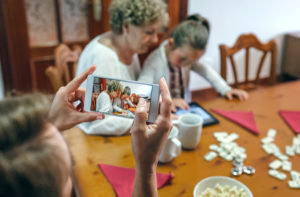
Vision and hearing are such simple yet very vital senses that must not be overlooked. Clearly labeling eyeglasses with a white out product so your permanent marker can show up is one trick. The same goes for taking a photo (so easy these days with smart phones) of the glasses on the person’s face so if they are ever lost in a hospital transition or misplaced in a congregate living environment you have an easy way to identify them. This trick was helpful with another client when her hearing aids went missing. Taking a photo (as well as keeping the model and style number handy) of those small devices made the search in Lost and Found a bit easier to rule out from the collection of hearing aids the nursing home had amassed.

Speaking of hearing aids – this is another area that, new batteries and plenty of them, can be so vital in assisting the person with dementia to really enjoy and participate in their surroundings. Like glasses, when a person can’t hear adequately, it adds to their confusion or desire to be reclusive and withdraw. Ensuring hearing aid batteries are unplugged at night and reinserted properly in the morning can be such a simple step and so necessary to ensure your loved one’s quality of life is maintained to the highest degree possible.

Mom is Gone

Founder and Executive Director Linda Fodrini-Johnson, MA, MFT, CMC

Founder and Executive Director Linda Fodrini-Johnson, MA, MFT, CMC

You know the time will come. You have been through many big and small health care dilemmas. You have prepared for her final care and found caring and loving people to be with her. You wish you could have done more but know you did your best with the information and support of professionals and family. Yet, when the time comes, it still hits your heart and soul like having the wind knocked out of you.

“This is the day that the Lord has made, let us rejoice and be glad in it.” Psalm 118:24. I can’t tell you why this scripture rings in me when I feel so much loss. But, it is a glorious sunny January day and though it began with her leaving, I think this Psalm is mom telling me, “I am at peace, dear family. Be glad in your life, rejoice with one another for I will always be part of each of you.” “Smile, joke, be positive and find the bright light in every day.”

We have been gifted by a mother who lit the way and guided each of her four children to be themselves, honor family, honor God and care for others. She has imprinted her hand on the hearts of us all.

So, the Academy Award and the Nobel Peace Medal for “Wonderful Mother” goes to Bernice Bidwell born on April 8, 1922 in San Francisco and died at peace, on January 30, 2013 in Walnut Creek.

“Taking Me Home?” Redirecting the Conversation

Founder and Executive Director Linda Fodrini-Johnson, MA, MFT, CMC

Founder and Executive Director Linda Fodrini-Johnson, MA, MFT, CMC

Many individuals, with different forms of dementia, ask from time to time or sometimes on every visit, “Are you taking me home now?”

My advice has been most of the time to these family members to say, “When the doctor says you can leave” or “When the plumbing at your house is fixed”. And then I suggest using distraction to redirect the individual from being fixated on the thoughts of home.

As family members, we need to remember that our loved one with a dementia associates us with whatever that memory of “home” is and however hard it may be, we need to answer quickly and simply – and then use redirection.

My mother is doing so much better but since she has moved into her small residential care home she has asked me on the last three visits, “Have you come to take me home?” Interesting, she even whispered this to me the last time so as not to let the care workers or the other residents know what she was asking. I am able to say, “When you no longer need the oxygen”. And, in the moment, she understands and we just chat about recipes or gardening – me asking her advice – which gives me a reason to “thank her” instead of her always thanking me for my visit.

The dance of “elder care” has it smiles, grief, tears and is full of creative opportunities to protect dignity.

Mothers’ Gifts for all Seasons

Founder and Executive Director Linda Fodrini-Johnson, MA, MFT, CMC

Founder and Executive Director Linda Fodrini-Johnson, MA, MFT, CMC

I am posting this picture of my mother for all of you to know that the end of life can be filled with dignity. Yes, she is in the very last phase of her life and on hospice but she has quality, despite her deficits.

Our mothers gave us life by birth or love and sometimes both. At this season of giving, I am so thankful for the gift of a loving mother who never put me down and always encouraged me to just do my best, to love God, country and family.

I am fortunate to have taken a professional path that enabled me to secure the very best at the end of life for my mother (and many of your parents as well). Seeing her smile lights my heart and will stay with me all the days of my life.

To paraphrase a line in a song, “fathers be good to your daughters, they will grow up to be mothers”. Love is what nurtures us all – love those close to you, respect them for who they are with all their imperfections – because we are all imperfect but love is not.

Merry Christmas and Happy Holidays!

Taking Me Home?

Founder and Executive Director Linda Fodrini-Johnson, MA, MFT, CMC

Founder and Executive Director Linda Fodrini-Johnson, MA, MFT, CMC

I moved my mother to a small residential care home that gives great care, at the same time I was scheduled to take a week’s vacation. When I returned six days later, I went to see how she was doing and the first thing she said, “How did you know I was here?” I explained I had picked out the home and she said it was a very good one (nice for me to hear).

She has vascular dementia so her short-term memory is impaired but she was very aware that she had not seen me in six days. We chatted for a few minutes with the other five residents before it was time to eat and then I accompanied her to the dinner table to continue chatting with her and all the residents.

As she finished her meal, she gave the caregiver a kiss and then a hug and thanked her for everything she had done for her and then turned to me and said, “Taking me home now?” Wow, I didn’t expect that. I said, “No, you need to stay here.” And she said, “What about my home?” Well, thinking she was talking about her home of 58 years I explained that her grandson was taking care of that house. She said, “No, the other house” and I responded with the name of the Assisted Living she had resided in for 18 months prior to two months in skilled care and she said, “Yes!”

I had to tell her we gave that up because we can’t pay for two places. She has always understood money and that was ok with her – while again telling me that this new home was a good home. I told her if she gets well, she could return to Assisted Living and she said, “Am I sick?”

Needless to say, I drove home in tears but, once I synthesized her comment, I was thinking how wonderful that she has no idea she is nearing the end of her life and that her sweet, tender heart is failing her.

Gracious, appreciative mom – I am privileged to be your daughter.

Life-giving and Integrity vs. Despair

Founder and Executive Director Linda Fodrini-Johnson, MA, MFT, CMC

Founder and Executive Director Linda Fodrini-Johnson, MA, MFT, CMC

What is “life-giving?” We are aware that in order to be a living creature, we all need air and substance (food and water) but the third and fourth elements will differ for each of us and, I believe, become more important as we age.

One is a belief in a higher power or a resolve in whatever one believes is the circle of life. This is inline with Erickson’s stages of life when he says, the last stage of development for us is to resolve the integrity vs. despair step. In simpler words, making peace with the whole of your life vs. longing for something that wasn’t or could never be for a myriad of reasons.

As I look at my mother’s life though, on Hospice, I see it was a simple life but she did accomplish that last Erickson task – and there is great integrity to the life she lived. I believe this is why she does not complain and is appreciative of every interaction – with “thanks” being expressed frequently.

The fourth element, which differs in each of us, is the environment we need to thrive. I mean both relational as well as the physical environments. I need times of complete quiet in my day. Days that are overfilled with “to-do’s” stress me and leave me anxious and actually interfere with sleep. However, I also long for the intimacy of spending quality time with my spouse, family and friends.

In my physical environment, I need nature but more specifically trees. And out of every window in my office and my home you can see trees. Why trees? I have no idea other than the fact that they are actually oxygen producing and stand tall during any weather. I also know that trees need to bend in order to be strong and over supporting them makes their trunk weak – just like people!

You each will need differing elements to be life-giving and, as you age, it will be important for you to keep that which gives your life meaning and importance in your everyday life.

Also when making decisions for others, remember to keep these four elements in the forefront and base your actions on what has been life-giving to this individual, not you – often they can be the same but, not necessarily.

Singing in the Rain…

Founder and Executive Director Linda Fodrini-Johnson, MA, MFT, CMC

Founder and Executive Director Linda Fodrini-Johnson, MA, MFT, CMC

When visiting a small residential care home to see a client I came at coffee hour and they were doing a sing along. One of the residents is very impaired with a dementia and can’t talk in complete sentences. Since I had prior experience running a day program for those with dementia years ago, I am very comfortable talking with her and responding to facial expressions and some of the words.

This woman, who is not my client, seems to always want to talk with me – I guess “dementia” is the one foreign language I have mastered! And, since she is not a family member, I have no history with her and we just have the moment of connecting words, facial expressions and feelings.

What truly surprised me on this most recent visit is this woman who can’t speak in a complete sentence or hold a thought very long knew every word to the tunes of our “grandparents” – she didn’t miss a verse of “You are my Sweetheart” or “Take me out to the Ball Game.”

The memory for music is held in a different part of our brain than memory and language. I have been thinking maybe we all need to put the names of those we love to a tune so we can sing it all our days.

Without a memory, you might not have words but you can still connect in ways that lift the spirit. Try “old” tunes to pass the time with those you love that might have a dementia like “Alzheimer’s”.